Friday, September 30, 2016

Malta - Palazzos and Cathedrals

Thursday, 22 September 2016

Malta is a small island -- it's easy to be anywhere on the island in less than an hour. Today we visited sites in Mosta, Naxxar, Mdina, and Valletta.

First stop was the big rotunda church in Mosta. It's difficult to get a shot of the entire front of the church, so this is four photos stitched together. Someone better than I could fill in the gaps in Photoshop. The church is modeled after the Pantheon in Rome.
The main altar in the church.
Like the Pantheon, the sanctuary is under a single, large dome. During World War II a German bomb came through the ceiling during mass. Remarkably (miraculously?) the bomb failed to detonate, no one was killed, and the church remained intact. (The one tile that is slightly different to the left of the lower edge of the oculus is where the bomb pierced the dome.)
A view of the rotunda church from Mdina. This photo also illustrates how Mdina had a view of the entire island of Malta -- that's the sea in the background.


Next stop was the Palazzo Parisio in Naxxar (the x's are pronounced as "sh"). The photo above shows the ballroom and is typical of the Baroque architecture and decor of the palace.
To my surprise, visitors are invited to play the piano in the foyer. And it's just not any piano -- as befits royalty, it's a Bösendorfer.
The extensive gardens set this palazzo apart from the many others on Malta.  The privately-owned palace is mostly used as an exclusive wedding venue, and the gardens are big part of the attraction.
The conservatory at Palazzo Parisio.


On to Mdina, the old Arab capital of Malta. Since it was built by the Arabs, it reflects Arab sensibilities on architecture and city lay-out. The streets are very narrow and winding. This helps keep them shady throughout the day.
The public piazzas like this one tend to be small -- gardens, courtyards, and atria provide private spaces within the palazzos. (See photo below.)
We visited the Palazzo Falson, which has an eclectic collection that the owners collected from all over the world. The actual house was more interesting than most of the contents. And the rooftop café had an astounding view.
A niche in the atrium of the Palazzo Falson.
A private courtyard in Mdina. When the Arabs left Malta, the conquering Normans returned the capital to Valletta to be next to the harbor. Mdina was turned over to the Malta aristocracy as "gated" community where they could build their palazzos.
Mdina Cathedral
The main altar in the cathedral.
A bell tower on the cathedral.


Our final stop of the day was the Lascaris War Rooms beneath Valletta. This is the location where the Allies planned the invasion of Sicily during WW II. This board kept track of bombers leaving and returning to Malta.
Wall map of Sicily and the "toe" of Italy in the Lascaris War Rooms.

Thursday, September 29, 2016

Malta - Valletta

Wednesday, 21 September 2016

We arrived in Valletta, Malta, this morning, and then spent the day exploring this beautiful city.

We came into Valletta at sunrise.
Valletta
A good comparison between our ship (right) and an average cruise ship (left). When we were in Civitavecchia, we saw the world's largest cruise ship, Royal Caribbean's Harmony of the Seas (below).
Royal Caribbean's Harmony of the Seas in Civitavecchia harbor. The ship typically has 5700 passengers!
As an old city, Valletta is full of narrow streets.
Valetta
Casa Rocca Piccola was the first house in Malta to have electricity. This painting commemorates the bringing of electricity to Malta!
Kiki the parrot greets visitors to Casa Rocca Piccolo.
It would be difficult to match (much less exceed) the excessive opulence of the Co-Cathedral of St. John in Valletta.
One of the chapels in the cathedral.
St. John's Co-Cathedral.
St. John's Co-Cathedral


Sicily - Agrigento, Valle dei Templi

Tuesday, 20 September 2016

In the wee hours of the morning, our ship left Licata and docked in Agrigento. The seas were somewhat rough. Fortunately, by the time we left Agrigento for Malta, the swells had subsided.

We spent the day in Agrigento, visiting the Valley of the Temples (Valle dei Templi) in the morning and the Archaeological Museum in the afternoon. We had time to see just two of the many temples in this site.

First stop was the Temple of Juno. The ruins were partially put back together in the 1700s. 
The front entrance of the Temple of Juno.
Between the Temple of Juno and the Temple of Concordia the road runs parallel to the original fortification wall (which is on the top of a steep hill). In the Roman and Christian era, the fortifications were turned into a necropolis (cemetery). (It seems that any vertical structure can become a necropolis!) Later some of these niches became stables. Everything can be reused!
The Temple of Concordia as seen from the Temple of Juno.
The Temple of Concordia. Built around 500 BC, the temple was converted into a church around 600 AD. Later, in the 1700s, the Christian modifications were removed, and the temple remains among the best preserved and most complete Greek temples in the world.
The front entrance of the Temple of Concordia.
Agrigento is home to Girgentana goats -- an endangered Sicilian breed that gives high quality milk


Sicily - Villa Romana del Casale

Monday, 19 September 2016

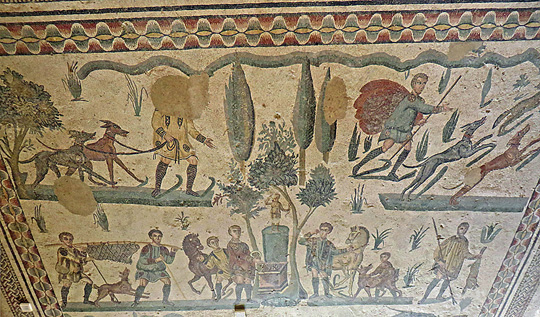
After lunch we visited the "Villa Romana del Casale". This villa was buried by a landslide, so it's many spectacular mosaic floors were well-preserved. The villa is a huge house, with very large rooms. Clearly it was owned by an extremely wealthy Roman landlord.

Many of the mosaics feature wild animals and hunting scenes. Was the owner a famous hunter?
Mosaics featuring people and animals were in public areas and living areas for the owners and guests.
Mosaics featuring geometrical designs were for servant quarters.
This fanciful mosaic was probably in the children's living quarters.
Exotic animals being loaded onto a ship.
An elephant being loaded on a ship. Images like this and the one above suggests that the villa owner may have been involved in importing exotic animals for gladiator events.
Perhaps the most startling mosaic is that of the "bikini" athletes. As you can see from the upper left corner, it was placed over an earlier mosaic.


Sicily - Syracuse

Monday, 19 September 2016

We started the day in Syracuse with a tour of the old city on the island of Ortigia. Following that, we spent some time at the nearby Archaeological Park.

Since this is the oldest part of the city, the streets are narrow.
Piazza Duomo. The Duomo is on the left, St. Lucy's Church is at the end of the piazza.
Duomo di Siracusa ("Syracuse Cathedral")
St. Lucy atop the Duomo.
The door of St. Lucy's Church.
Looking to the inside courtyard of the Commune di Siracusa (Syracuse City Hall) on the Piazza Duomo.
Open door and two cats.
Greek theater in the Archaeological Park.
Romans and Christians turned the back of the theater into a necropolis. During the Middle Ages this area was the site of workshops and businesses such as tanneries and mills.
Water was brought into the theater area via a 7-km long tunnel.
Mt. Etna was visible as we made our way by bus to the town of Piazza Armoria in the center of Sicily.